




Context and Intended Precision Shooting Role
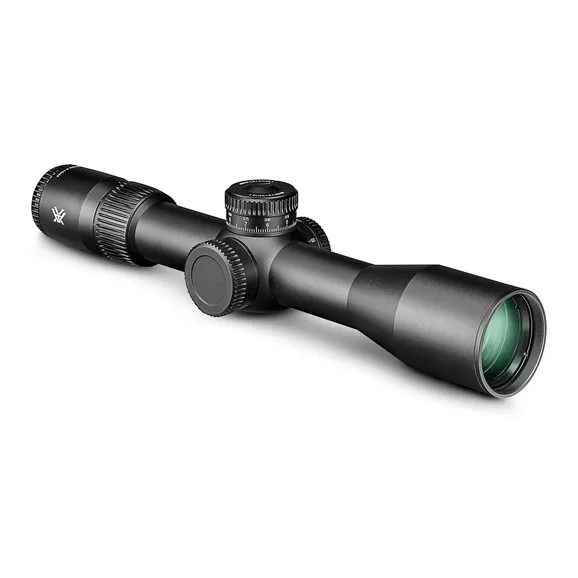
The Vortex Venom 3–15×44 FFP has been designed as a versatile precision riflescope for tactical shooting, mid-to-long-range target work and precision rimfire disciplines such as NRL22.
Rather than pursuing the extreme magnification and extensive optical architecture of dedicated ELR scopes, the Venom concentrates on providing the essential features required for accurate ballistic shooting within a more compact and accessible configuration.
Its combination of 3–15× magnification, a 44 mm objective, first focal plane EBR-7C MRAD reticle and 34 mm main tube gives the optic a useful balance between target acquisition, magnification and mechanical adjustment capability.
The 0.1 MRAD turret system, RevStop zero system and generous internal adjustment range further reinforce its role as a genuine precision optic rather than simply a general-purpose scope.
This balance becomes particularly important in disciplines such as NRL22. Although the rifle may be considerably lighter and more compact than a full-size centre-fire precision rifle, the shooting problems remain fundamentally the same. The shooter still needs to:
-
Locate targets quickly
-
Account for ballistic drop and wind
-
Establish a consistent aiming reference
-
Make repeatable corrections
The Venom is therefore best understood as a practical precision platform. It provides the optical and mechanical features required for serious target shooting without becoming unnecessarily specialised for extreme-distance applications.
Optical System Design and Target Resolution
One of the principal strengths of the Venom lies within its fully multi-coated optical system, designed to provide useful brightness, contrast and clarity throughout the 3–15× magnification range.
At moderate magnification, optical performance is particularly important for target acquisition. The shooter needs to locate a relatively small target quickly while retaining enough surrounding visual information to understand its position relative to the terrain or target array.
As magnification increases, the requirements change.
At 15×, the optic needs to provide sufficient resolution to distinguish target edges and establish a precise aiming point. This becomes especially relevant with small steel targets used in precision rimfire competition, where the target may occupy a relatively small portion of the sight picture even at substantial magnification.
The Venom's optical design is therefore not simply intended to produce a brighter image. Its practical purpose is to provide sufficient contrast and resolution for the shooter to extract useful information from the target at the magnification being used.
This balance between field of view and resolution is one of the reasons the 3–15× configuration works particularly well for mixed-distance precision shooting.
Why a 44 mm Objective Makes Sense
The 44 mm objective represents a deliberate middle ground within a precision optic.
At 15× magnification, the theoretical exit pupil is approximately 2.9 mm. This provides a useful amount of illumination to the shooter's eye while allowing the scope to remain substantially more compact than optics built around 50 or 56 mm objectives and much higher magnification ranges.
This is particularly relevant to rimfire precision rifles.
A precision rimfire rifle is often built around positional shooting, rapid movement between stages and unconventional firing positions. An unnecessarily large optic can add weight and bulk without providing a proportional benefit within the distances at which the rifle is normally being used.
The 44 mm objective therefore complements the Venom's intended role. It provides sufficient optical aperture for the 15× maximum magnification while helping maintain a relatively manageable overall package.
The result is an optic that can provide substantial magnification without turning the rifle into a disproportionately large system.
Magnification Range and Practical Target Shooting
The 3–15× magnification range is one of the Venom's most useful characteristics, giving the shooter flexibility between rapid target acquisition and more precise aiming.
At 3×, the optic provides a relatively broad field of view of approximately 42.4 feet at 100 yards. This wider view allows targets to be acquired quickly and makes the optic more forgiving when shooting from positions where the rifle may not initially be perfectly aligned with the target.
At 15×, the field of view reduces to approximately 8.4 feet at 100 yards. Increasing magnification progressively narrows the field of view while enlarging the target image, allowing the shooter to transition from target acquisition to precision aiming without changing the fundamental sighting system.
For tactical precision shooting, this flexibility allows the optic to accommodate relatively close targets as well as more distant engagements.
For NRL22, it provides an equally useful balance. A shooter can use lower magnification when moving between targets or when a stage requires rapid target acquisition, then increase magnification when a small or distant target demands greater aiming precision.
The 3–15× range therefore provides considerably more flexibility than an optic optimised around a single magnification level.
First Focal Plane EBR-7C MRAD Reticle
The first focal plane configuration is one of the most important features of the Venom.
Because the EBR-7C reticle is positioned in the first focal plane, its subtensions remain proportional to the target throughout the magnification range. This means that the reticle's MRAD references remain usable for holds, ranging and corrections regardless of whether the optic is being operated at 3×, 10× or 15×.
This characteristic is particularly valuable for dynamic precision shooting.
The shooter is not required to select a particular magnification simply to ensure that the reticle's ballistic references remain accurate. Instead, magnification can be selected according to the target and shooting position.
This can make a significant difference during timed stages. A shooter may initially require a relatively wide field of view to locate a target before increasing magnification to refine the aiming picture. With an FFP reticle, the same angular references remain valid throughout this process.
The reticle therefore becomes an integrated part of the ballistic system rather than simply an aiming crosshair.
Understanding the EBR-7C MRAD Reticle
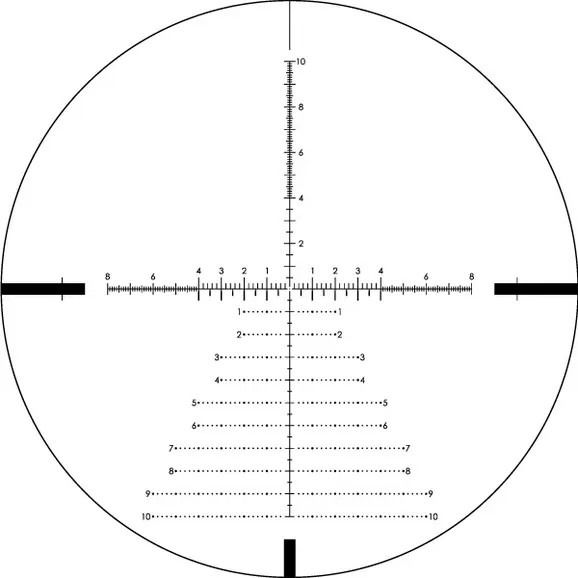
The EBR-7C is considerably more sophisticated than a conventional duplex reticle and is designed around the requirements of long-distance shooting.
Its elevation and windage references provide the shooter with a series of angular reference points that can be used for:
-
Drop compensation
-
Wind corrections
-
Ranging
-
Moving-target leads
The reticle uses fine centre-crosshair subtensions intended to balance precision aiming with visibility, while windage reference dots provide additional correction points.
This becomes particularly useful when shooting small targets.
Rather than relying exclusively upon the elevation turret, the shooter can use the reticle itself to apply a ballistic hold. Similarly, wind corrections can be introduced through the horizontal references without necessarily changing the mechanical elevation or windage settings.
This gives the shooter greater flexibility in how a firing solution is applied.
For NRL22, where ammunition velocity and environmental conditions can produce meaningful changes in point of impact even at comparatively modest distances, having a detailed MRAD reference system can make ballistic corrections considerably easier to visualise.
The consistency between the reticle and the 0.1 MRAD turret system also means that both mechanical adjustments and reticle holds use the same angular measurement system.
0.1 MRAD Adjustment System
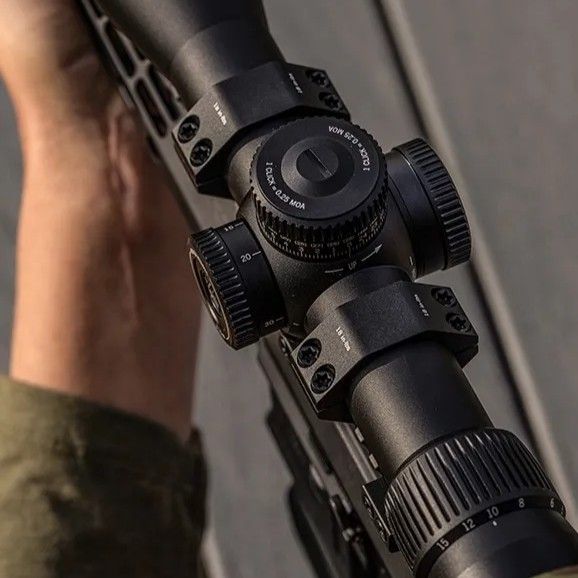
The Venom uses 0.1 MRAD adjustment increments, providing a precise and easily quantifiable method of correcting point of impact.
A 0.1 MRAD adjustment represents approximately 1 cm at 100 metres, with the linear effect increasing proportionally as distance increases. This makes the system particularly intuitive for shooters working with ballistic data expressed in milliradians.
The advantage is not simply the small adjustment increment itself.
Using a consistent angular measurement system between the ballistic solver, reticle and turret means the shooter can move from calculated correction to physical adjustment without converting between different units.
For example, if a ballistic solution calls for a 1.4 MRAD elevation correction, the turret can be adjusted directly by fourteen 0.1 MRAD clicks. Alternatively, the same angular correction can be represented through the appropriate reticle hold.
This consistency simplifies the interaction between the shooter and the optic.
34 mm Tube and Adjustment Range
The 34 mm main tube is a particularly significant feature for an optic of this class.
Compared with a smaller main tube, the larger diameter provides the internal architecture required for a generous amount of elevation and windage travel.
The Venom provides:
-
36 MRAD of elevation adjustment
-
21 MRAD of windage adjustment
-
10 MRAD of travel per turret revolution
This is considerably more adjustment capability than would be necessary simply to establish a conventional zero.
The additional travel becomes useful when the optic is being employed for ballistic shooting at extended distances. Rather than running out of elevation adjustment as the required correction increases, the shooter has a substantial mechanical range available.
The 10 MRAD-per-revolution system also makes larger corrections easier to track. A shooter can establish a known zero reference and then dial substantial changes while maintaining a clear understanding of the amount of adjustment introduced.
For precision rimfire shooting, this can be particularly useful because the relatively pronounced trajectory of a .22 LR cartridge can require significant elevation correction even at distances that would not be considered extreme for centre-fire cartridges.
RevStop Zero System
The RevStop zero system provides a mechanical reference for returning the elevation turret to the established zero after adjustments.
This is particularly useful for precision shooting because the shooter may alternate between dialling corrections and returning to a known zero throughout a session.
A zero system reduces the amount of attention required to keep track of the turret's position. Once the reference has been established, the shooter has a defined mechanical stopping point rather than relying entirely upon memory or visual counting.
For NRL22, this can be especially valuable when moving between stages with different ballistic requirements.
The ability to make an elevation correction and subsequently return confidently to the established zero contributes to the overall repeatability of the system.
Parallax Control and Rimfire Precision
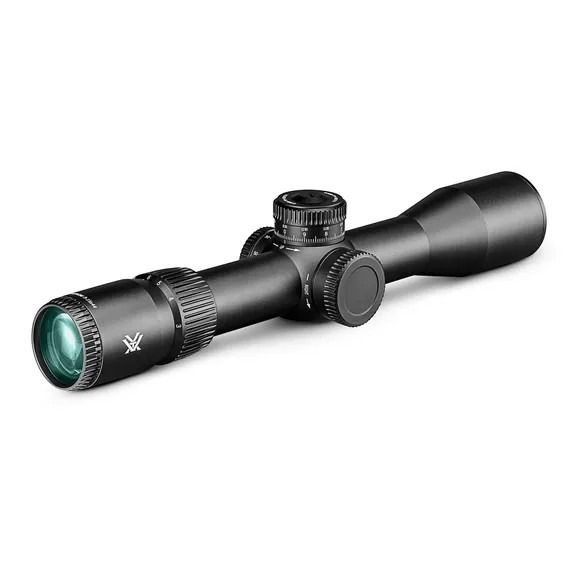
The Venom provides parallax adjustment from 10 yards to infinity, giving it a particularly broad operating range for precision shooting.
This is important for NRL22 because precision rimfire stages can involve targets at relatively short distances as well as more extended engagements.
At 15× magnification, this becomes increasingly important. Small targets occupy a greater proportion of the sight picture, and any apparent movement between the reticle and target caused by parallax or inconsistent head position can become more noticeable.
Correct parallax adjustment therefore forms part of the overall precision system, particularly when shooting small targets where a relatively minor angular error can determine whether the shot impacts the intended scoring area.

Mechanical Construction and Field Reliability
The Venom is built around a 34 mm aluminium main tube and is designed to provide a robust mechanical platform for the optical and turret assemblies.
The construction is intended to withstand recoil and the physical demands associated with regular precision shooting, while weatherproofing protects the optical system against water and fogging.
The physical dimensions are also relevant to the scope's intended role.
At approximately 13.3 inches long and 28.8 ounces in weight, the Venom remains a relatively manageable precision optic. This makes it particularly well suited to rifles where overall weight and handling characteristics remain important.
In precision rimfire disciplines, this can be valuable because the rifle may need to be manipulated through multiple positional stages rather than simply fired from a static bench.
A large, excessively heavy optic can alter the balance of the rifle and increase fatigue during a long competition. The Venom instead provides a substantial precision feature set without requiring the physical dimensions of a dedicated extreme-range optic.
Tactical Precision Applications
The 3–15× configuration is particularly well suited to tactical precision applications where target distances can vary considerably.
At lower magnification, the shooter benefits from a broader field of view and faster target acquisition. Increasing magnification provides additional target detail for more deliberate engagements.
The first focal plane EBR-7C ensures that the reticle remains usable throughout this process, while the 0.1 MRAD turrets provide a direct mechanical interface for ballistic corrections.
The combination of exposed elevation adjustment and capped windage also provides a practical balance between accessibility and protection from unintended changes.
Elevation can be adjusted quickly when engaging targets at different distances, while the capped windage turret provides additional protection against accidental movement.
The result is an optic that can support both deliberate long-range shooting and faster tactical-style engagements without becoming overly specialised for either.
NRL22 and Precision Rimfire Applications
The Venom's characteristics are particularly well matched to precision rimfire disciplines such as NRL22.
The relatively modest 3–15× magnification range is sufficient for the distances normally encountered in rimfire precision shooting while still providing a broad enough field of view for rapid target acquisition.
The 44 mm objective keeps the overall optic reasonably compact, while the 34 mm tube provides substantial elevation adjustment capability.
The FFP EBR-7C reticle is arguably even more significant.
Rimfire ammunition can exhibit considerable trajectory changes as distance increases, and environmental factors such as wind can have a pronounced effect on a lightweight .22 LR projectile. A detailed MRAD reticle therefore gives the shooter a practical method of applying corrections without relying exclusively upon mechanical turret adjustments.
Combined with 0.1 MRAD turrets and a RevStop zero system, the result is a complete ballistic interface suited to the demands of precision rimfire competition.
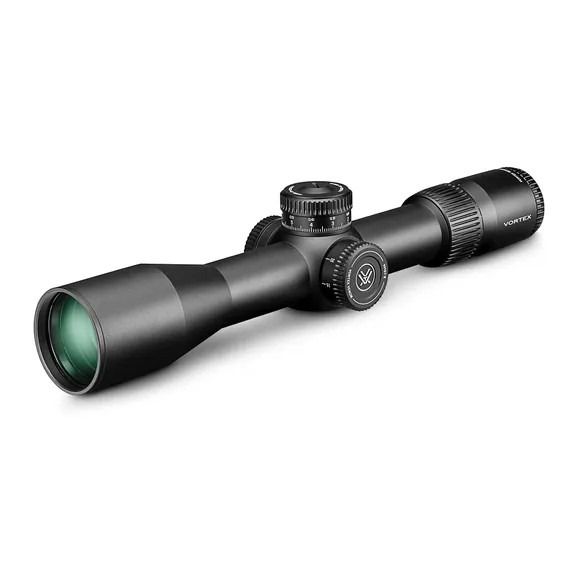
Overall Engineering Assessment
The Vortex Venom 3–15×44 FFP EBR-7C 0.1 MRAD represents a particularly balanced approach to precision riflescope design.
Rather than attempting to compete with extreme-magnification ELR optics, it concentrates on the features that matter most for tactical precision, mid-to-long-range target shooting and precision rimfire competition.
The 3–15× magnification range provides a useful combination of field of view and target resolution, while the 44 mm objective keeps the optic relatively compact. The first focal plane EBR-7C MRAD reticle provides consistent angular references throughout the magnification range, allowing the shooter to use holds and ranging references without being restricted to a particular power setting.
Mechanically, the 34 mm tube provides substantial adjustment capability, with 36 MRAD of elevation travel, 21 MRAD of windage travel and 10 MRAD per revolution. The 0.1 MRAD adjustment system keeps turret corrections consistent with the MRAD reticle, while the RevStop system provides a dependable reference for returning to zero.
These characteristics make the Venom particularly compelling for shooters who require a genuine precision optic without the additional size and extreme magnification associated with dedicated ELR systems.
For tactical precision shooting, it provides the flexibility to move between different target distances while retaining precise ballistic references. For mid-to-long-range target shooting, it offers sufficient magnification and adjustment capability to make accurate corrections at extended distances. For NRL22, its combination of manageable size, broad parallax range, FFP reticle and substantial elevation adjustment makes it particularly well suited to the demands of precision rimfire competition.
The Vortex Venom 3–15×44 is therefore best understood as a versatile precision optic rather than a scaled-down extreme-range scope. Its engineering is focused on providing the shooter with the optical clarity, ballistic references and mechanical adjustment capability required to make precise shots across a broad range of practical target distances.
Click Here to Shop - Vortex Venom 3-15x44 FFP EBR-7C .1MRAD 34mm Rifle Scope